I enjoyed a recent repeated episode from NPR’s On Being that discusses the way the brain works, and how we can choose influences for our brain.
I identified just a little with Richard Davidson. The part that struck me was just a moment in the longer interview where he acknowledges how he kept two interests apart (science and contemplative practice). In the 1990s he “came out” and pursued the scientific study of the effects of meditation on the brain of Buddhist monks, finding interesting things. Davidson is now applying teaching kids and adults simple strategies of meditation practices to address concerns such as ADHD and autism. This work is incomplete, but intriguing nonetheless.
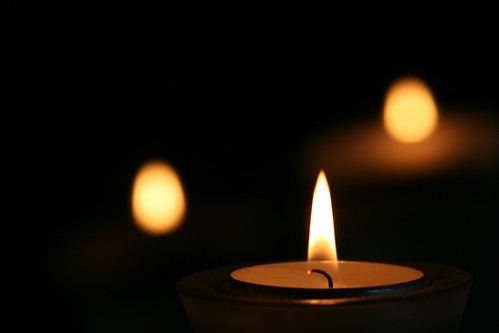
Candle light, made available through Creative Commons by Alesa Dam on Flickr
Not that these things are necessarily opposed, but there is some rejection of religion, mysticism, and spirituality in the culture around science (at least that’s my experience of science graduate school in the 1990s). Given that meditation practices originate in religious traditions such as Hinduism and Buddhism….Well, scientific inquiry and spiritual practices don’t seem to go together. On the other hand, many scientists are meditators. So they’re not entirely opposed.
In my own life, I’ve kept these things separate, rarely mixing the friends or conversations I have from each sphere. Only recently (after a gap of maybe 10 years…) have I brought friends from other spheres to my meditation center. I can rationalize this as no one being interested and me being afraid to evangelize, but I expect I participated by not giving others a chance to express their interest because I never mentioned it.
In my experience, when I’m withholding part of myself from a conversation or a moment, I am hobbling myself and limiting what I can contribute. So, I’m inspired to more fully integrate the perspective of my meditation practice into my daily life.
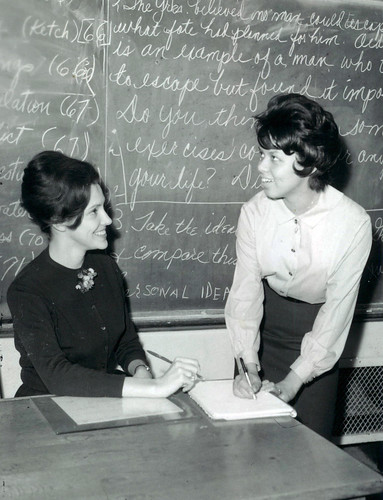
My mom in her first career as a high school English teacher
I spoke on “Writing for On-Screen Consumption: Tips, Tools & Techniques” at the Original Equipment Suppliers Association – Automotive Public Relations Council meeting on February 28, 2012. Quick summary here: APRC Meeting Teaches Not So Old Dogs Some New Tricks.
I used the career changes my mom has had in her lifetime and her passion for learning to illustrate the nimbleness required to keep current. I also mentioned a few free tools helpful for writing to be read on screen and to be found online. Longer descriptions and the motivation for these tools can be found in our book!
Writing for On-Screen Reading
Techniques
write to be skimmed – people read only about 20% of the words on a web page (source)
Pro Tip: Insights for Search provides a quick visual to support keyword choices, the AdWords tool provides deeper insight and more alternatives.
Upcoming Events
Wednesday March 14, 2012, I will emcee the Princeton University and Michigan All-Ivy Club “Global Net Night” event where regional associations all around the world will meet to network with other local Princetonians (and other Ivy Leaguers) and hear a presentation by Mark Gilman of MCCI on Personal Branding.
The Iyengar yoga teacher I have mentioned several times, Elise Browning Miller, is coming back to Michigan. I cannot wait!
Her classes will be hosted by the Michigan Yoga Association in Kalamazoo. The workshop details are in a PDF on their website. I thought I’d republish them here in HTML to make them easier to share.
Saturday April 21, 2012 10AM-12:30PM, 2PM-5PM Yoga for Back Care – Saturday
This session will address different back issues and injuries resulting in poor posture, lower back pain, chronic neck and shoulder pain, scoliosis and other back conditions. Elise will address how to adapt certain yoga poses for a wide variety of back conditions including scoliosis and give a series of therapeutic yoga poses for those back conditions. Appropriate for those dealing with their own back related issues as well as yoga teachers and those who treat these conditions in others.
Sunday April 22, 2012 9AM-noon Heart Opening through Backbends
Elise will lead students through standing poses to prepare for an uplifting backbend practice. Elise will pace the class so that students will feel secure enough to work with a variety of backbend poses. Students should be familiar with standing poses and beginning backbends.
Sunday April 22, 2012 1PM-3PM Forward Bends and Twists: Freedom or Frustration?
Many students with spinal and hip joint challenges struggle with forward bends and twists. Elise will cover how to practice and teach these important categories of poses safely and effectively.
Costs & Registration
Friday Yoga for Scoliosis class $65 separately
Saturday and Sunday classes $150
Location: Transformations Center, 3427 Gull Road, Kalamazoo, MI
I didn’t do a New Year’s Resolution this year, but one got me anyway.
Elise Browning Miller, an Iyengar yoga teacher who specializes in Yoga for Scoliosis, conducted a weekend yoga workshop in Chicago in early January. Egged on by a friend who was also interested, I attended.
Elise taught some familiar poses and I learned some good tweaks and some advanced poses not in the DVD. We also enjoyed a wonderful teacher:student ratio as Elise instructed the instructors who helped us students. Three items came to be my most important learnings:
Elise emphasizes lengthening and derotation for scoliosis, and from the corrections she gave me throughout the workshop, I seem to have been better at lengthening and needed coaching on the derotation. My current theme in my home practice is derotation.
The workshop helped me notice I was not breathing equally into my lungs and ribs. With coaching I brought attention to the lower left of my back, and I expanded my intercostal muscles where my scoliosis compresses my ribcage. Doing so, I could take deeper breaths and experience greater well-being in each breath.
The biggest take-home lesson for me was how I felt each day of the workshop. My lingering lower back twinges and aches were simply gone. I wanted that feeling to last.
I wanted to learn how to make myself feel that good, that whole, that comfortable in my body on my own. Of course, I already knew exactly what to do – what I had been doing in her previous workshops and with her DVD. Nothing secret or mysterious, just requires the actual doing rather than mental understanding. The answer was obvious: commit to a daily home practice.
I had long wanted to do this and then felt guilty about not doing this….and also resistant, all at the same time. I groused that too many things wanted my daily attention including meditation and other exercise.
I knew from my experience commiting to a daily meditation practice that I had to commit to adding daily yoga in the morning. If I let myself plan for it to be later, I’d stress about it and/or worm out of it somehow. Putting meditation first thing in the morning short-circuited my avoidance mechanisms.
Clock in the Basement of the First National Building
But, I did not think I could wake early enough to do both yoga and meditation each morning before work. So I decided to make an experiment: move my established meditation practice to the evening and start each day with yoga.
I told two friends, one of whom shared her experience that confirmed mine, the other just egged me on (and I knew if I told more people, I’d be committed).
I worried about the earlier alarm in the morning (even with moving the meditation, I still needed to get up earlier). And I’ve never been a happy-wakey person. I’m grumpy and slow and resistant in the morning.
Yet, four days in, I’ve had no trouble whatsoever. I even wake up more easily than before (so far) and I’m finding I have more energy throughout the day.
I look forward to Elise’s return to Michigan April 21-22, to teach Yoga for Back Care, Heart Opening Through Backbends, Forward bends and Twists. Her visit will be hosted by the Michigan Yoga Association. Location and details TBD at this writing.
I’ve been suffering from some lower back stiffness and pain, and after many experiments, I have found that changing my work ergonomics, heat, and a set of exercises have helped.
Well, this sometimes painful, usually stiff lower back thing has been bothering me the last two summers and the fall, winter, and spring in between. It would come on especially after exertion (cycling, weeding, planting, lifting) to the point where I started doing less and less just to avoid twinging it. I fear sneezing, because it can to cause a mirrored spasm in my lower back. Boo.
What didn’t work
Waiting for it to go away
It sounds silly to say now, but waiting until the “edge came off” didn’t work. Cycling did seem to exacerbate it, I’d be doubled over in pain about 24-36 hours after a ride, so I hung my bike up in the garage and haven’t ridden it in over a year. But, I shunned other exercise (personal training, going to the Y) because it wasn’t helping me get better either.
I kept hoping I would finally eliminate the “thing” that was causing the stiffness/soreness. I kept waiting for the twingey pain to stop. But it didn’t. So my ultimate discovery was rest did not solve the problem. Now I need to rebuild without hurting my back.
Palliative care
I resist taking too much ibuprofen, figuring I’d rather treat the cause than the symptom. I also feared increasing the injury by feeling better than I actually was.
I also worked with my massage therapist on it. But, while she unknotted me, it didn’t change the situation fundamentally.
I worked with a chiropractor, which did seem to help a little, and I was able to extend the time between sessions before I felt locked up again. Yet, whatever it is/was remained. Going to see someone once a month didn’t change the situation.
What did work
I decided after 16 or 18 months of chronic pain I had to make a drastic change.
Changing my work ergonomics
I moved to a stand-up desk at work. And I heard my uncle and my mother discussing how they’d both used a stand-up desk at their place of work for decades. I realized I have a very similar body to theirs, so I should pay attention to how they care for their backs! My work was happy to let me experiment with the furniture, and we rigged up a standing desk that works well for me. I switched to it full time after Labor Day.
I felt good in the position and it was an easier adjustment than I expected, tho I’m someone who spends a fair bit of her day in conference rooms so do get lots of sitting/movement breaks. My back seemed a little more loose after the transition, like it was recovering.
Heat
I was feeling tight and uncomfortable at my mom’s house after a recent bout of enthusiastic gardening knocked me over. She slipped me a ThermaCare heat wrap, and honestly, I’m completely in love with them now (no I have no relationship with them other than as a consumer). Eight or so hours of mild heat really seemed to sink in and relax my back. A hot water bottle was kind of awkward, a microwaved pack was first too hot and then quickly too cold. The ThermaCare wrap was specifically for the lower back, held itself in the right place with a waistband, and hid mostly under clothes (not bulky).
Specific strengthening and lengthening exercises
I did try stretches throughout the experience and of course I continued my yoga classes. But my yoga class only seemed to make me aware of where I was stiff and limited. I didn’t break through it.
As for stretches to reduce the pain, when it was in spasm, I couldn’t find anything to release it. And when I wasn’t in pain, it was hard to tell whether any routine mattered. And some of the stretching routines I tried were long and annoying and I wasn’t sure they made a difference. So, I never got very serious about them.
Yoga: Anytime, Anywhere
I had Carol Blackman and Elise Browning Miller’s book Yoga: Anytime, Anywhere (Amazon affiliate link) for a couple of years before I engaged with it seriously. I’ve benefitted from Elise’s workshops and her yoga for scoliosis DVD. And I took it up north with me this summer and dug into her chapter on “Strengthening and Lengthening Your Lower Back”. These simple exercises helped me wash the creakiness out and give me a better range of motion and fewer twinges of pain. Better yet, their benefit persisted long enough to make me want to commit to a routine.
Yet, I still resist the routine of doing it. I currently do them in the evenings, but I expect that soon I’ll end up moving them into my morning routine, since I seem to accept routine more in the mornings! To ease my annoyance with looking up what to do next in the book all the time, I recently recorded my voice on to my phone narrating the instructions for the sequence.
Next Steps
Now that I think about the timespan, I suspect that my back twinginess is more caused by inactivity than solved by it. I just realized I have been living in our new home for a little over two years, and I know my activity has decreased since moving from a neighborhood where I walked everywhere to one where a car is required. It’s hard to get motivated for exercise when you fear worsening a chronic condition, yet that must be a way out, especially now I am armed with a set of exercises that take the edge off.
So, with cautious optimism I am committing to the strengthening routine and will add back in more vigorous exercise as I heal my back.
We use cookies to improve your experience and analyze our traffic. Please see our Privacy Policy for more information.

 ) and books in my home practice. The Chicago event, at the lovely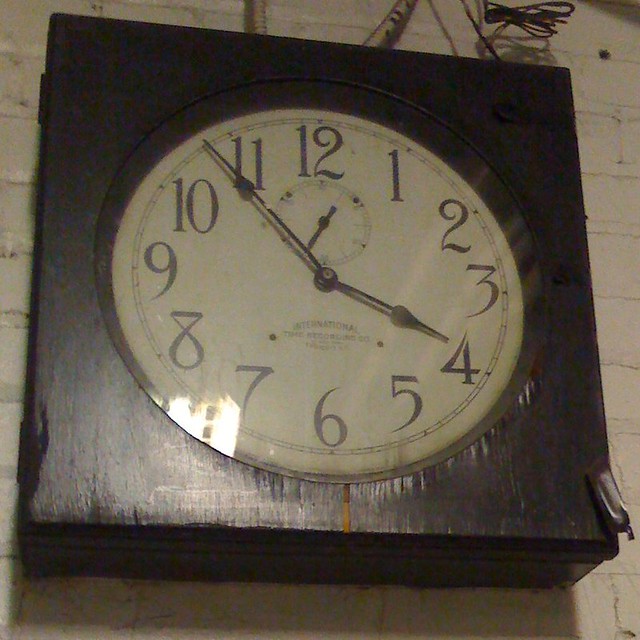

 for a couple of years before I engaged with it seriously. I’ve benefitted from Elise’s workshops and her yoga for scoliosis DVD. And I took it up north with me this summer and dug into her chapter on “Strengthening and Lengthening Your Lower Back”. These simple exercises helped me wash the creakiness out and give me a better range of motion and fewer twinges of pain. Better yet, their benefit persisted long enough to make me want to commit to a routine.