Last fall, I listened to Dawn of Midi‘s Dysnomia on repeat as I drove, as I wrote, as I cooked. I found it via the RadioLab podcast. I loved the sense of driving seemingly-electronic music slowly morphing, and I loved to hear that it wasn’t electronic at all, but humans playing to sound like machines. The layering of sound and story was what caught me, but the music kept me.
This summer and fall, I’ve been listening to the xx‘s two releases on repeat. I discovered them via the New Yorker’s profile, Shy and Mighty.
Two different artists and sounds, but both triggered my play daily on repeat response and I thought I’d share. Both are good as foreground or background, which is a hard thing to do.
I know making music and getting paid for it these days is tough going, so if you like these songs, go support the artists and buy their music!
I just completed some go-to-market research for a scientifically-oriented business-to-consumer company. In this research, one of my tasks was to assess consumer sentiment and project possible customer loyalty for a new product launch. Things like customer-lifetime-value, ecommerce conversion rate, and loyalty would be wonderful to have from our competitors, but these KPIs are closely-guarded secrets.
While I loved spy novels as a teen, I am not up for corporate espionage. I do not need to break into competitor website analytics to uncover insights into consumer behavior. I asked consumers about their buying habits and loyalty directly, online.
My research on online consumer surveys turned up two options – Survata and Google Consumer Surveys. I believe I had heard of Google Consumer Surveys and then found Survata by searching for competitors of Google in the consumer survey space.
Similarities
Both show a short survey to give a reader access to gated content. Both offer a handful of questions for a buck or two a completed survey. Both help publishers monetize their visitors. Both offer geographic, age, and gender targeting, which happens, I imagine based on the target demographic of the content on the gated sites.
Both survey engines offer visualization help to understand your survey answers, including visualization of subsets within your answers. Both survey engines provide some sense of statistical significance of any trends in the data. Both require prepayment to run the survey.
Differences
Qualifying Question – Advantage Survata
When I started earlier this summer, Google Consumer Surveys did not offer the chance to have a qualifying question. So if the website visitor met your demographic criteria (say a certain age, your specified gender, maybe your region of interest) they answered your surveys. If you wanted males under the age of 45, great. If you wanted males under the age of 45 with small dogs, not so great.
Since then, Google has added a qualifying question option. The survey client (me in this case) only pays for respondents who answer the qualifying question correctly (e.g. people who answer yes to having a small dog).
Google’s restriction is they need the qualifying question passed at a minimum amount, otherwise they bounce the survey back to you. Apparently, my qualifying question was too stringent. Google kept my payment for the survey and issued me a coupon in lieu of a refund. However, since I don’t want people who don’t meet my criteria to answer my survey, I’m a little stuck as to how to use the coupon.I would have preferred a full refund, so I can get my questions answered at Survata! [edited 10/22 – Google issued me a refund for the incomplete survey].
As far as I can tell, Survata does not have a minimum response goal for the qualifying question. In fact, I used the same qualifying question for both the Survata and the Google Consumer Survey so I anticipate its success rate was similar in both environments. Survata did not bounce my survey.
Cost – Advantage Survata
The two survey engines are both inexpensive, but Survata is less expensive. For a 5-question survey, I paid about $1/response for US respondents from Survata. The qualifying question was not included in the question count. Google Consumer Surveys includes the qualifying question in the count, and I paid about $2/response for US respondents for 4 questions after the qualifier.
Support – Advantage Survata
I had a great experience with Survata. Prior to each survey launch, I got feedback on my questions and setup from a survey analyst. The analyst edited my survey, and I got to see the before and after version and approve it before launch. My analyst was available to me via email, in my survey dashboard, and via IM throughout the process. I also had a follow up call so that I could understand the survey results and get a quick orientation to their visualization engine when the survey was complete. I ran a handful of surveys and was able to work with the same analyst rather than starting anew each time.
Survata – Analyst review before and after
Google Consumer Surveys did a review of my questions ahead of launch as well, but the experience was less caring. I got a basic email detailing what was wrong with my survey and telling me what to do to fix it.
Google Consumer Survey edit request email.
Survata’s help was more helpful – they did the work for me and asked for my approval. Google made me their admin.
Data/Results Visualization – no Advantage
I liked the user interface, question previews, and results analysis engines for both survey vendors.
Publisher Network – Advantage Google?
I imagine with Google’s reach and reputation, Survata has stiff competition. I have not encountered a Survata survey on a website. I did see my first Google survey yesterday, on the Christian Science Monitor website. In case it’s not obvious, this is not my survey, though it is relevant to my home state, Michigan.
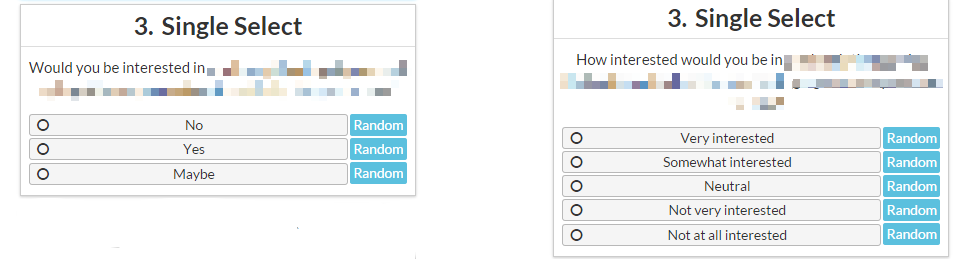
Google Consumer Survey encountered on the Christian Science Monitor website.
I prefer Survata
The survey engine (user interface, options, everything) for both Survata and for Google Consumer Surveys changed during my project. So, this review is a snapshot of an evolving set of features. Right now Survata has a strong edge in customer service. I had a good relationship with my survey analyst and a positive experience with the company. My experience with Google was more at arm’s length (only email, always from someone new) and ultimately unsatisfying due to their rejection of my survey after taking my money. [edited 10/22 – Google issued me a refund for the incomplete survey].
Short version: I strongly preferred my interactions with and the results I got from Survata.
In March I changed my work setting. I left my job of almost seven years and moved to independent marketing consulting and writing. Although I have my share of meetings at client sites and in coffee shops, I typically work and write in my home office.
What I feared
I’m an introvert. I’m restored by quiet and work productively alone. That means I should like this situation, and I do. Yet, I was worried I might get isolated or isolate myself. The work I do requires me to reach out to others, for expertise, for feedback, for work, so I haven’t gone underground, it’s not possible.
I was worried I’d “go native” with the cats, get even more quiet and watchful. While that’s kind of a joke, I did think that being social was like a muscle. If I didn’t exercise it or keep in practice, I would drop back to previous levels of social awkwardness. In the last few months, I have had my usual share of awkward moments, but I don’t know if it is more or less than before. Probably about the same.
When I left my position, I thought I’d miss my team–I do miss them individually and as a group. I have to make a team or gather input from people less officially connected to my fate and my projects. It is a little more conscious and less spontaneous now, but others are still available. While I’m mostly on my own during the day, I’m hardly solo. Friends, collaborators, and mentors are as close as a phone call, an email, or a drive across town to a lunch date.
What surprised me
I thought I loved our open, collaborative workspace. Yet, I find working in a quiet office has increased my feeling of well-being. When I worked in a leadership position in our open office, I felt I was on-stage and yearned for privacy and quiet in my off-hours. I found myself procrastinating returning personal phone calls on weekends and weeknights. I sometimes felt overwhelmed by the need to be social, engaging, upbeat.
I am finding more social energy now that my need for quiet and privacy are better met. So my social reserve is more like a well, it needs time to replenish, and it is less like a muscle that needs to be kept in shape.
Next Steps
Clients and colleagues have offered me drop-in space at their offices, and Ann Arbor offers a great coworking space, the Workantile. So I have options if I need to work near others. Hasn’t happened yet, but it is nice to have a choice.
I can be a minimalist. There’s almost nothing I like better than organizing things for disposal. I like to give away books (to friends, to the library); I like to give away clothing I haven’t worn for a while. I love to reuse cardboard boxes that come in the mail – to organize items for travel, to use for a gift box – and then to recycle them. I resent “wasting” money on gift packaging, preferring to reuse what I’ve received. I love using leftover yarn as ribbon and I have used newspaper once or twice to wrap a gift even recently. Yet there is some packaging that I cannot bring myself to reuse or recycle.
It’s well-designed and carries sweet memories, and I can’t bear to part with it, even though I detest clutter.
I cannot part with….
Tiffany Boxes
Over the years, I’ve received a few Tiffany gifts. Great-Aunt Jane and Great-Uncle Chuck gave us crystal candleholders for our wedding, and I’ve thought of them and recalled our wedding day each time we use them. More recently, Delta Airlines has been giving Tiffany Gift Cards as an option for their Diamond Medallion members as a year-end perk. Smart choice: For the frequent business traveler, give the wife something sparkly to distract her from your absence.
Tiffany packages everything as a gift — the gift card has its flat box and white ribbon and then the item it purchases gets its own box and ribbon. Each step in the chain brings more white-ribbon-wrapped Robin’s egg blue boxes, a series of gift experiences. The boxes are lovely and I enjoy the whole experience, even though the boxes (especially the ones for the gift cards) become immediately useless. Reusing them seems out of the question. It would be such a let down – to receive something that’s not Tiffany in a Tiffany box! Yet, I have a difficult time tossing them. So they pile up, and I try to use them for special items, like the puff of our sweet cat Floyd‘s fur I found behind the couch, years after he passed away.
Stella & Dot Boxes
When you go to a Stella and Dot party (my neighbor had one, a colleague of mine at work had another), you can order jewelry and it will be delivered to your home. Like Tiffany, each item is packaged as a gift, and the items I’ve purchased have been for me, so a couple of gift boxes hang around after I start wearing the jewelry. The boxes are colorful and printed with nice patterns, and they have a couple of steps to open them (a paper case that slips off before you can open the box).
The Stella and Dot boxes sat around and I could not reuse them (again, it would be strange to give it without Stella and Dot inside). Eventually, I summoned the courage to pull them apart and recycle them. It took a while.
The box for Gerla Chocolates
In Turin, Gerla makes wonderful hazelnut-chocolates (gianduiotti) that Dave brings back from his trips to Italy. Similar to the Delta gift of a Tiffany gift card, I think this tradition started through the canny wisdom of his distributor colleague there – give a gift to keep the wife amused while the husband is in Italy. The Gerla boxes are a strange shape: kind of semi-rounded with squared edges. And I’ve taken to reusing them for knitting supply storage (needles, notions) because, again, I simply cannot toss them.
Wrapping for Gifts from Japan
The wrapping pinnacle is Japanese packaging – special bottles of sake and special cakes have made it home from Japan tucked in Dave’s luggage. Each item is perfectly wrapped in many layers. Typically a printed cloth or paper surrounds a lightweight perfectly fitted blonde-wood box surrounding another layer of insulation (or custom cut wood inserts) surrounding the present. Because neither we nor most of our gift recipients read Japanese, these items are easier to reuse. I use the paper or the cloth to line drawers or shelves and the boxes get repurposed for Christmas gift boxes.
Great Wrapping extends the Gift
When I encounter the wrapping, a decorative liner underneath my cosmetics in their drawer, knitting needles stuffed into a Gerla box, special treasures safely tucked inside Robin’s egg blue boxes, I remember the gift, the giver, and re-experience a positive feeling about the brand. Well done, Tiffany, Stella and Dot, and Gerla designers for attractive packaging that makes the gift last.
I officiated at the wedding of friends earlier this month. The bride and groom wrote their own vows and the ceremony, and they invited me to share some thoughts about love and marriage in the middle. What follows is a paraphrase of what I said, with more of my story and less about the bride and groom than was in their ceremony on their day.
After choosing a great partner, our next choice is to choose the marriage, over and over again.
The big events are easy: the right choice is obvious. For instance, when Dave had an opportunity to move to England for work, I took a year of detached study from graduate school and went with him. When I worried about not being with my dad ahead of an operation, Dave said, “why don’t you just go?” So I did.
A lifelong marriage contains a few big events and hundreds of thousands of small moments: in person, on the phone, in email, via text…In those moments, we have a choice of how to respond to what happens to us and between us.
The good news is that we don’t have to choose perfectly, enough good choices make a marriage resilient.
My blessing for my friends was that they continue to choose each other, that they have the experience Wendell Berry articulates in this poem:
The Wild Rose
Sometimes hidden from me
in daily custom and in trust,
so that I live by you unaware
as by the beating of my heart,
suddenly you flare in my sight,
a wild rose blooming at the edge
of thicket, grace and light
where yesterday was only shade,
and once more I am blessed, choosing
again what I chose before.
My inbox is getting full of marketing messages about Father’s Day, and I don’t like it.
OpenTable would like to help me make reservations at a local restaurant for Father’s Day brunch. Two Guys Bow Ties might ensure he’s snappily dressed for the occasion. Princeton U-Store wants me not to forget the college-themed gift, ThinkGeek offers up some nerd fun, and LocalHarvest and Vosges wonder if I should get my dad some yummies.
Topical messaging is good. Bothering me is bad.
While I am all for fatherhood and dads, especially my own Dad, all of the Father’s Day messaging rubs me the wrong way. I am not a parent and my Dad has been dead about 16 years (wow…longer than I thought).
Dear Brand I choose to follow, why do you want to remind me of my loss? Not a good strategy for you.
If there were a holiday opt-out in email marketing, Father’s Day would top my opt-out list. I imagine I’m not alone, folks with recent losses or who are facing infertility may be even more sensitive than I am.
Until I can opt-out of holidays that poke me, I might set up an email filter to avoid having these little reminders interrupt what is otherwise a fine day.
Manage Consent
To provide the best experiences, we use technologies like cookies to store and/or access device information. Consenting to these technologies will allow us to process data such as browsing behavior or unique IDs on this site. Not consenting or withdrawing consent, may adversely affect certain features and functions.
Functional
Always active
The technical storage or access is strictly necessary for the legitimate purpose of enabling the use of a specific service explicitly requested by the subscriber or user, or for the sole purpose of carrying out the transmission of a communication over an electronic communications network.
Preferences
The technical storage or access is necessary for the legitimate purpose of storing preferences that are not requested by the subscriber or user.
Statistics
The technical storage or access that is used exclusively for statistical purposes.The technical storage or access that is used exclusively for anonymous statistical purposes. Without a subpoena, voluntary compliance on the part of your Internet Service Provider, or additional records from a third party, information stored or retrieved for this purpose alone cannot usually be used to identify you.
Marketing
The technical storage or access is required to create user profiles to send advertising, or to track the user on a website or across several websites for similar marketing purposes.