Author: Dunrie

  • Sustainable Future Forum 2024 – Ann Arbor

    Sustainable Future Forum 2024 – Ann Arbor

    Today I had the pleasure of being the emcee for the first ever a2tech360 Sustainable Future Forum. Laura Berarducci and the team at Ann Arbor SPARK put together a great program of talks from sustainability leaders and innovators.

    We learned from Sartorius, Toyota North America, Wacker Chemical, and the University of Michigan. We cheered on four innovation highlights: ThermoVerse, Fourth State, 4M Consolidated Brands, and Next Cycle. We celebrated the Ann Arbor Green Business awardees.

    My favorite part was meeting other folks committed to sustainability including students, community members, consultants, and entrepreneurs.

    Why Sustainability Matters to Me

    Here are my Sustainable Future Forum opening remarks interspersed with images from my slides.

    First, let me tell you a little of my story. I’m Dunrie Greiling. 

    I am a lifelong Michigander and I’ve lived in Ann Arbor for thirty years. 

    Cherry orchard – Photo by Nicole Geri on Unsplash

    I love living here – I love the proximity to farmland, both for the open landscape and the fresh high quality food from our local farms. Did you know that Michigan has over 300 agricultural products which puts us with the second most agricultural diversity in the nation, second only to California? 

    A photo of vegetables at a Michigan farmers market
    Farmers market vegetables – stock photo

    I love our open spaces, the eskers, the dunes, the forests, the lakes and rivers.

    Kirtland’s warbler – stock photo

    I love the birds and their worms, the insects that sing in the trees, and the frogs that gobble them up. 

    Michigan lake – stock photo

    I love escaping up north, jumping into cold lake water (makes me feel alive in the best way), I love spending time with friends and family next to a beach bonfire or a fireplace. 

    I love the four seasons: the spring flowers: trillium, liverwort, trout lily,

    photos of trillium, liverwort, and trout lily
    Trillium, liverwort, and trout lily – personal photos

    the long summer days,

    A moth in my backyard in Ann Arbor – personal photo

    the gorgeous colors of our fall forests,

    Photo by Aaron Burden on Unsplash

    and the stillness of the woods after a fresh clean snow.

    Photo by Aaron Burden on Unsplash

    I wouldn’t want to live anywhere else. 

    Michigan lavender farm – stock image

    Protecting access to all of that requires healthy farms, healthy forests, clean and safe air, water, and soil, biodiversity, and reducing or reversing our contributions to climate change.

    Image of Liberty Street in Ann Arbor
    Photo by Brad Switzer on Unsplash

    At the same time, I love the dynamism of our college town. I appreciate the growth in town–even though sometimes simply getting across town has been difficult because of all of the construction. We need to build to accommodate our community, we need to build to keep people employed, we need to keep the great ideas that originate in this smart, problem solving community here in our region. 

    These are the ingredients of what makes Ann Arbor and this part of Michigan so great: nature, growth, and innovation. And these things need to be balanced. How to do it is not always obvious. 

    Photo by Michael Loftus on Unsplash

    I have a Ph.D. in plant ecology from the University of Michigan, and I have worked in software startups for the last few decades. The common thread for me has been mission-driven: my latest startup experiences have been focused on access to justice, then access to safe drinking water. Now I’m working on the organizational sustainability of a biodiversity scientific organization, iDigBio

    My niece has just started at the University of Michigan and I’m spending more time with her, and I’m thrilled one of her interests is environment. I’m inspired by her environmentalism. The world is in front of her and she’s so talented and she is part of a generation who is idealistic and motivated. They make me want to be a better person, set a better example. They make me want to have, to make, a better world for them to inherit.

    Image from Earth Overshoot Day #movethedate

    I heard on the radio recently that Earth Overshoot Day – the day of the year when we’ve consumed more than the earth can generate in a year – already happened this year. It was August 1. That means that every day since the beginning of August humanity has overdrawn our account with the sun, the water, and the organisms on our planet. 

    The UN recognizes a triple planetary crisis of climate change, pollution and biodiversity loss.

    The triple planetary crisis refers to the three main interlinked issues that humanity currently faces: 
    climate change, pollution and biodiversity loss
    Each of these issues has its own causes and effects and each issue needs to be resolved if we are to have a viable future on this planet.

    United Nations unfccc.int/news/what-is-the-triple-planetary-crisis

    This is a lot, right? We are up against some real challenges. 

    We have some choices ahead. Yet not quite the way we might think. We sometimes feel like we have to choose – nature or economy. Housing for people or habitat for plants and animals. This dualistic oppositional thinking is not going to get us where we need to be. It’s not one or the other. We aren’t separate from the world around us. We have to find a way to balance nature and economy, habitat for people, plants and animals, production and protection and preservation, for our shared future.

    Beach grass – stock photo

    We need entrepreneurship and innovation to solve complex problems so we as a society can learn to grow with balance. We need each other – both to support each other and hold each other accountable. Maybe most importantly, to do all this we need stories. Stories of success, examples of leadership and creativity to light the way to inspire us to recognize solutions and bring them to life. 

    Lighthouse Photo by Hans Isaacson on Unsplash

    That’s why I’m here today – to hear stories from innovators, leaders, and the community about our shared sustainable future. I trust that is also why you’re here. Thank you for coming and we’re going to have a great day.

    My Closing Remarks

    So on behalf of everyone here, I’d like to thank you again.

    Given the complexity of the challenge we are up against we will need more than just the innovations we heard about today. We will also need the innovations that each of you is dreaming about, and to make that happen, we need to come together, like this today, to hear and celebrate progress, to hold ourselves, our community, and our leadership accountable to our commitments, and we need to do the work of socializing and fundraising to implement these changes. 

    What’s our call to action? Make sure to connect with people you met today on LinkedIn, over tea, via text. Let’s keep the stories going, keep them alive. Together we can bring about a Sustainable Future.

  • Join me at the Sustainable Future Forum 2024 – Ann Arbor

    Join me at the Sustainable Future Forum 2024 – Ann Arbor

    Join me at Sustainable Future Forum, a2Tech360’s first sustainability event!

    We will hear about successful sustainability initiatives at international companies (Sartorius and Wacker Chemical), green tech entrepreneurs including Shantonio Burch from ThermoVerse, and cheer the City of Ann Arbor’s green business challenge award winners. I will emcee.

    See you there!

    Update – we had a fabulous time. Hope to see you at the next one.

    In between, join us at the monthly Sustainability & Innovation meet-up.

  • Leadership in the Environmental Sector

    Leadership in the Environmental Sector

    Panel photo from Leaders Connect on Environmental Leadership January 2024
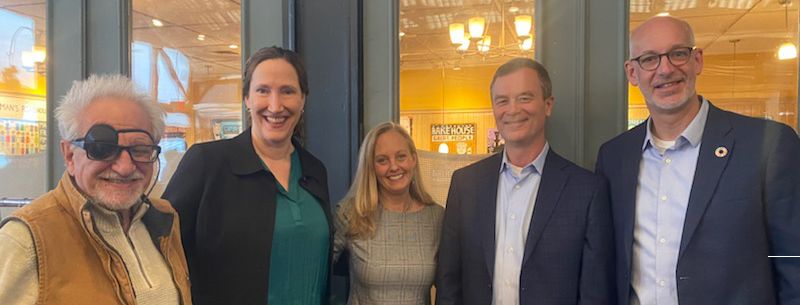
    Rob Pasick, Dunrie Greiling, Lisa Wozniak, Phil Roos, and Timothy Dekker at the Leadership in the Environmental Sector

    In late January, I moderated a panel at Rob Pasick’s Leaders Connect on environmental leadership. The panelists included

    • Phil Roos, the Director of the Michigan Department of Environment, Great Lakes, and Energy (EGLE)
    • Timothy Dekker, PhD PE, the CEO of LimnoTech
    • Lisa Wozniak, the Executive Director of the Michigan League of Conservation Voters

    Each of the speakers shared about their journey to their current leadership positions, their philosophy of leadership, and advice for aspiring leaders. The audience also asked good questions about community involvement and the future and current impact of AI/ML on environmental solutions.

    Here’s Rob’s overview of the leadership in the environmental sector panel.

    Their advice for aspiring environmental leaders

    Lean into what you’re good at and don’t pretend you’re going to be good at everything. Be humble in recognizing where you need to bring in smart people to be part of your team and trust them, give them responsibility that they can own and run with.

    Lisa Wozniak, 1:04:50 in video

    If you’re a young leader, really spend some time learning how to write. If you can pair your scientific expertise, or your very technical expertise, or your legal or policy expertise with that abiliy to write you really can change the world.

    Timothy Dekker 1:07:34 in video

    We’re all on a lifelong journey of figuring out why we’re on the planet, what we’re supposed to do, what we’re passionate about, [and] how does that fit with what needs are in the world. And I think it is about constructing for yourself a lot of experiments: ways of trying different things that gradually lead you to that union between who you are and what you’re about, why you’re here, and some pressing issue in the world that needs to be solved.

    Phil Roos 1:08:33 in video

    Thanks to the panelists for sharing your wisdom and stories. Thanks to Rob for a great morning!

  • Showcasing My Work at BlueConduit

    Showcasing My Work at BlueConduit

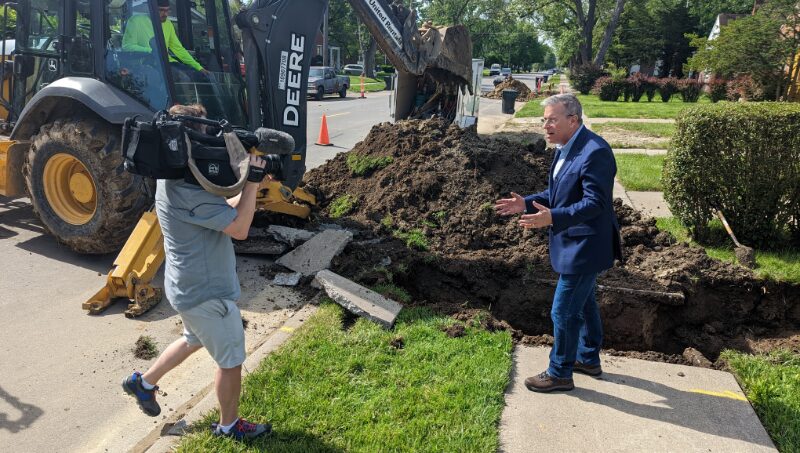
    Behind the scenes at the recording of the Spotlight on America episode on our work in Detroit.

    While at BlueConduit, I directed thought leadership efforts to demonstrate the power of predictive analytics in water infrastructure—through customer success stories, expert insights, and strategic communications.

    Below is a selection of content we developed to engage and inform water system leaders, sharing key lessons from our work with communities across the country.

    Articles and Analysis

    Media and Video Storytelling

    These pieces reflect BlueConduit’s mission to empower communities with data-driven solutions and my ability to turn complex innovation into compelling, accessible stories.

  • Posted Elsewhere #2

    Posted Elsewhere #2

    My previous posted elsewhere entry did not include at least one thing I’m really proud of, so I wanted to extend that list here.

    Through Matterhorn’s work, we got to know and collaborated with John T. Matthias on an article for the NCSC‘s 2020 Trends in State Courts. In the piece, we discuss how our courts deserve best of breed technologies and the interoperable standards required to provide that. Here’s the link: Assembling a Case Management System Through Lego-Like Blocks. [note – there’s no longer a direct link. please go to page 20 in the PDF]

    Even more exciting was our article was adjacent to another one about the success of online dispute resolution in Franklin County, Ohio, written by Alex Sanchez and Paul Embley on page 14. Fun to be in such good company :).

    Photo of lego-like blocks.
    Photo by Glen Carrie on Unsplash

  • A Day to (pokeberry) dye

    In late September, 2020, it was finally time to dye my wool and Kelly’s thread with the pokeberries. After gathering pokeberries for two months, we had collected over 2.5 kg (over 5 lbs) of berries. We took our stored berries out of our freezers the night before to thaw them.

    Preparing the pokeberries

    It was both during the pandemic and messy, so we worked outside in the yard and on the deck. We sat in the yard with our bags of thawed berries. For those berries still on their stalks, we stripped them from the stems. Others were already stripped, and some already squished (thanks Lilah!).

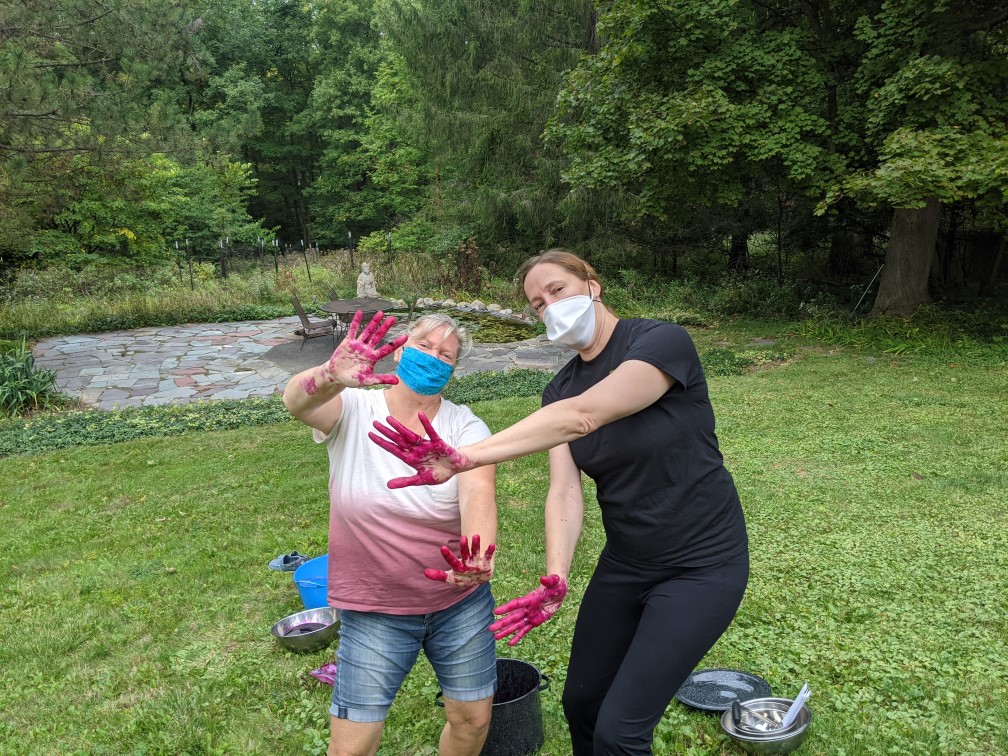
    I never wanted to dye my phone/camera purple when I had the purple hands, so I don’t have photo evidence from gathering. Here we are in the yard with our red-purple hands.

    Two people in a yard with red-purple hands.
    Kelly and me in the yard. Our hands are red-purple from prepping the pokeberry stalks for the dye vat.

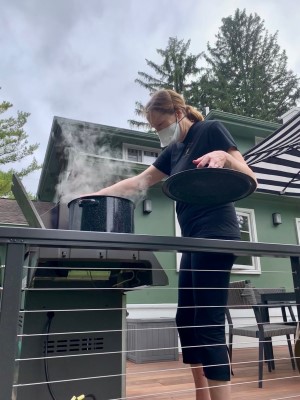
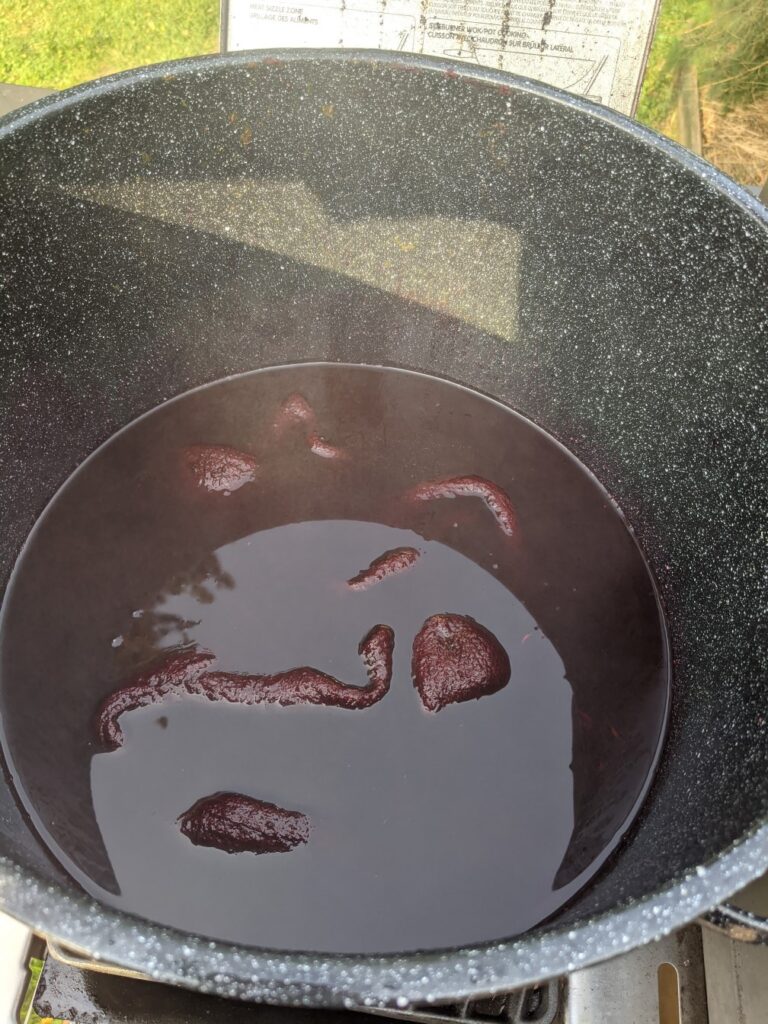
    We cooked the berries in water and vinegar outside on the grill. The pokeberry dye instructions in Rebecca Burgess’ book Harvesting Color: How to Find Plants and Make Natural Dyes calls for cooking the berries for ninety minutes to extract the color. It cautioned not to boil the berries as that may alter the color.

    The searing burner on our gas grill is really only meant to go hot, so I had to keep on turning the burner off and on and adjusting the pot’s lid on and off to keep the mixture in the range of 160-180 degrees Fahrenheit.

    After ninety minutes, we strained out the pulp and seeds, leaving an almost-opaque purple liquid.

    How we used the pokeberry dye

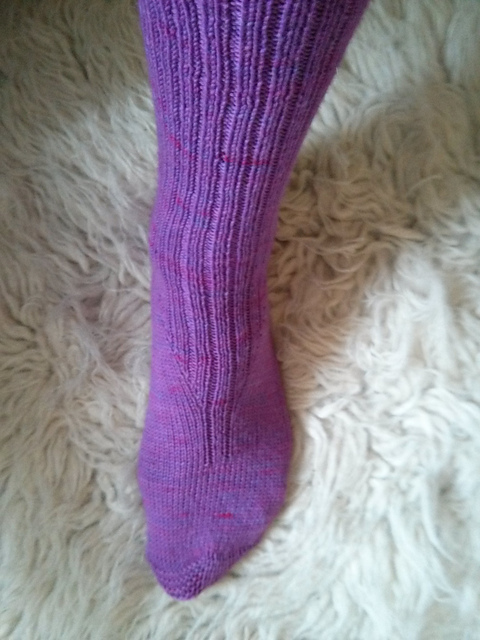
    For this first dye project, I planned to re-dye a made object rather than unknitted yarn or unspun roving. I had knitted a pair of socks in 2013 (the socks on Ravelry) that I wanted to re-dye. They were holding up well with use and fit nicely, except the bright “purple Viking” color was fading. When I hand-washed them, the blue part especially was bleeding out in the soak. My lovely fuschia socks were turning a muddy rose color.

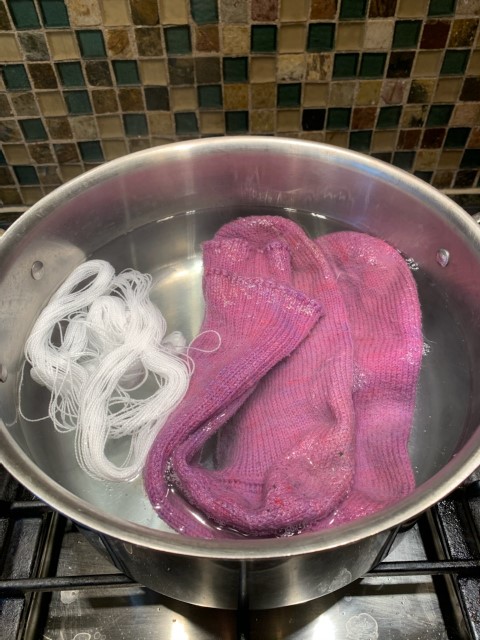
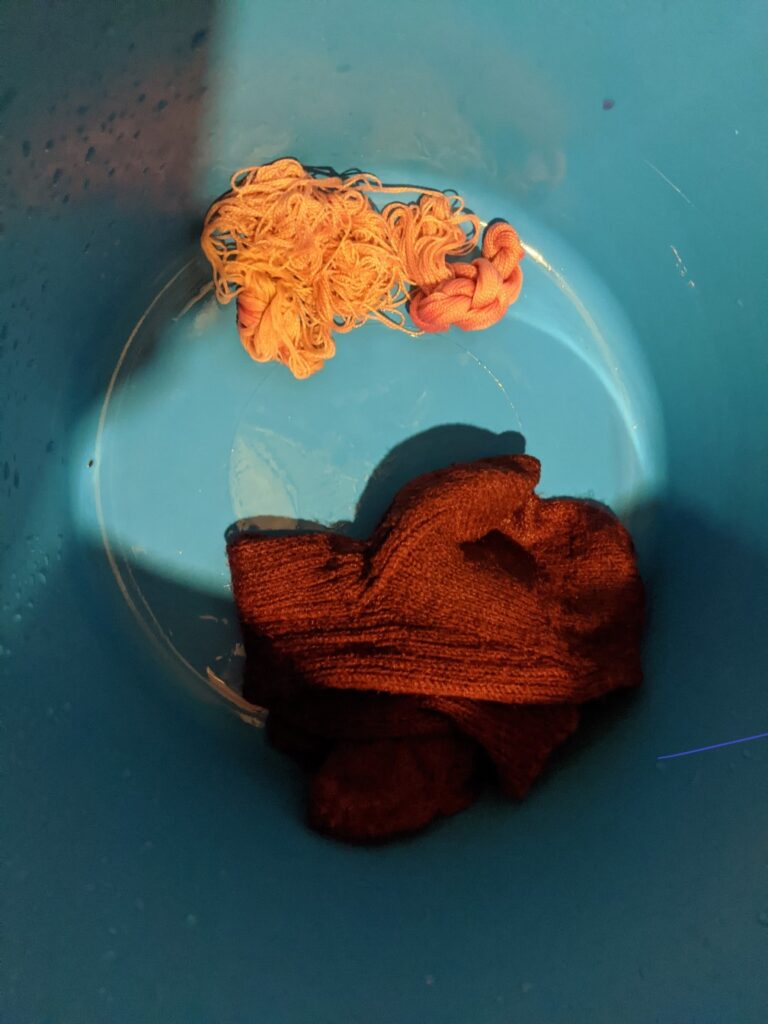
    You can see that the socks in the pre-wetting pot in 2020 are less bright than in the photo in 2013. I did hear from a yarn-store owner that I could use vinegar to help the color hold (for example, here’s an article from Purl Soho on re-fixing dye). The treatment seemed to slow the loss of color but, of course, it didn’t restore the color that had been lost.

    Kelly brought some thread to dye for a stitching project.

    The instructions in Harvesting Color: How to Find Plants and Make Natural Dyes called for pre-wetting the fiber in a warm solution of water and vinegar. We did that indoors on the stove.

    Finally pokeberry dyeing!

    After two months of gathering berries and some time pre-wetting the fiber and extracting the color from the berries, it was time to dye. We put the socks, the embroidery floss into the pokeberry liquid and watched them turn a deep fuschia color.

    We heated our items in the dye pot for another 90 minutes, again turning the burner off and on to maintain the right temperature window. After 90 minutes, I took the whole pot off of the burner and put it on the patio to let it steep overnight.

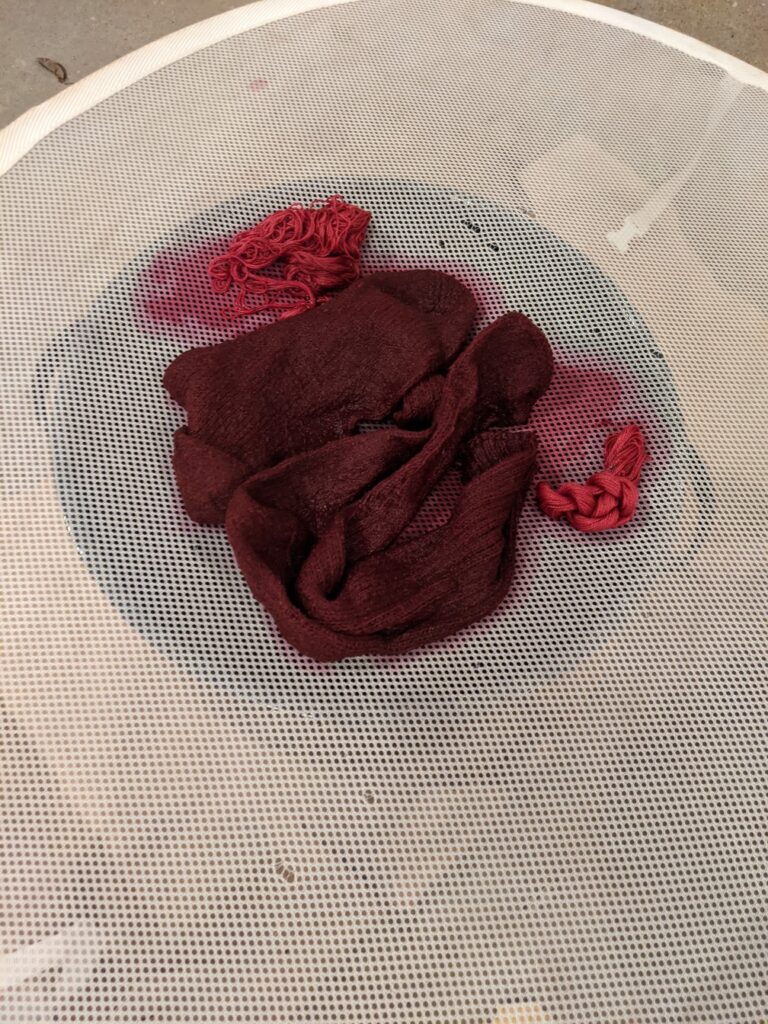
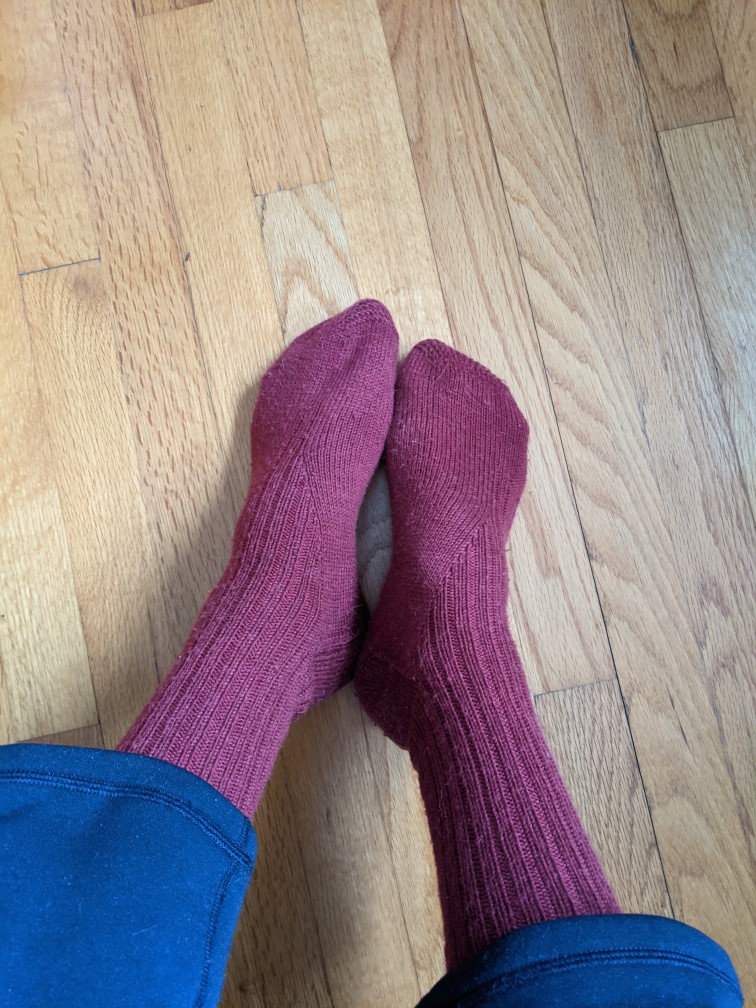
    In the morning, I pulled the items out of the dye vat to let them drain. Then, I rinsed them. The items let a lot of dye out. The socks remained a beautiful rich deep color but Kelly’s thread gave up most of the purple and stayed only a little dingy pink. We were so disappointed!

    Still, it was an experiment and the socks are beautiful. Plus we had a day in the warm sunshine experimenting with old tech (fire and plant dyes) and new things for us.

    Dye another day

    The main change I’d make to this setup was how to heat the dye pot. On the grill burner, the pot’s temperature was all over the place. The off/on dance I had to do with the burner and the pot lid was pretty fussy and I’m sure error prone. I’m glad the dye didn’t suffer too much.

    Ultimately, that burner is poorly suited to keeping things below a simmer. Next time I will try a slow cooker, something designed to be on a lower temperature for a long time.

    Overall, this was a wonderful afternoon of dyeing after a lot of fun gathering. Now I’m eyeing Sumac berries on my walk.