I officiated at the wedding of friends earlier this month. The bride and groom wrote their own vows and the ceremony, and they invited me to share some thoughts about love and marriage in the middle. What follows is a paraphrase of what I said, with more of my story and less about the bride and groom than was in their ceremony on their day.
After choosing a great partner, our next choice is to choose the marriage, over and over again.
The big events are easy: the right choice is obvious. For instance, when Dave had an opportunity to move to England for work, I took a year of detached study from graduate school and went with him. When I worried about not being with my dad ahead of an operation, Dave said, “why don’t you just go?” So I did.
A lifelong marriage contains a few big events and hundreds of thousands of small moments: in person, on the phone, in email, via text…In those moments, we have a choice of how to respond to what happens to us and between us.
The good news is that we don’t have to choose perfectly, enough good choices make a marriage resilient.
My blessing for my friends was that they continue to choose each other, that they have the experience Wendell Berry articulates in this poem:
The Wild Rose
Sometimes hidden from me
in daily custom and in trust,
so that I live by you unaware
as by the beating of my heart,
suddenly you flare in my sight,
a wild rose blooming at the edge
of thicket, grace and light
where yesterday was only shade,
and once more I am blessed, choosing
again what I chose before.
My inbox is getting full of marketing messages about Father’s Day, and I don’t like it.
OpenTable would like to help me make reservations at a local restaurant for Father’s Day brunch. Two Guys Bow Ties might ensure he’s snappily dressed for the occasion. Princeton U-Store wants me not to forget the college-themed gift, ThinkGeek offers up some nerd fun, and LocalHarvest and Vosges wonder if I should get my dad some yummies.
Topical messaging is good. Bothering me is bad.
While I am all for fatherhood and dads, especially my own Dad, all of the Father’s Day messaging rubs me the wrong way. I am not a parent and my Dad has been dead about 16 years (wow…longer than I thought).
Dear Brand I choose to follow, why do you want to remind me of my loss? Not a good strategy for you.
If there were a holiday opt-out in email marketing, Father’s Day would top my opt-out list. I imagine I’m not alone, folks with recent losses or who are facing infertility may be even more sensitive than I am.
Until I can opt-out of holidays that poke me, I might set up an email filter to avoid having these little reminders interrupt what is otherwise a fine day.
We rented a canal boat in France in May with friends. We piloted it ourselves and moved between small towns on the Saône, the Seille, and the Canal du Centre in Burgundy. We had a great vacation, enjoying the sights, the countryside, the cheese, and of course the wine of France.
Five of the six of us had taken French in high school, one much longer, and so we got by in French much of the time. Additionally, the English of many folks in the hospitality industry was much better than our French, so we switched often. For instance, we conversed easily with the staff at the port where we picked up and dropped off the boat, the mechanic who came to help us when we had battery trouble, people in restaurants, and the staff at the capitaineries where we payed to moor the boat, hook up to shore power, and take on potable water.
Some in the group enjoyed using their French, while others of us felt overwhelmed. My joke is that I don’t really like speaking in English, and speaking in French is even more intimidating! Still, we enjoyed the little pleasantries, such as when we bought our pain au chocolat in the morning, we chatted amicably in French with the vendor. We said we were happy to have the pastries because we were hungry, to which he replied “c’est une bonne maladie!” A good problem, especially in France. Before we left, he wished us a pleasant journey, a great day, and a few other nice things. It was difficult to match the ardent good wishes and blessings we received!
M. Malaprop strikes!
As you might expect, we managed a few hum-dingers with our half-remembered French. We had a wonderful time at the tasting room of Domain Mestre Père et Fils in Santenay. It took us a lot longer than we expected to traverse the eleven locks from the Saône up to the wine country on the Canal du Centre. The locks make canal travel slow-going, and our trip was further slowed when we got stuck in one of the automatic locks. Its doors closed after the first boat exited and before we were able to leave, so we had to wait for the remote lock-keeper to drive up and free us. We became fast friends with the lock-keeper and saw him on several of the locks going up the Canal and then going back down the next day.
By the time we got to Santenay, we were running up against the end of the day. We had called ahead, and although we were initially told they closed at 6PM (or 18 hours), we switched to English with someone else on staff who offered to give us a wine tasting if we arrived before 6PM. We got to Santenay a little after 5PM, and although it was a short walk from our mooring on the Canal du Centre to the center of town and the tasting room, it likely wasn’t much before 6 when we arrived at the tasting room.
We had a wonderful tasting, we enjoyed the wine, learned a lot, spoke in both English and French, and picked up some bottles for later in our trip. We would have bought more if we could take it home easily. At the end of our tasting, after we were shown their wine cave with stacks and stacks of bottles below the tasting room, we thanked our host in French. Instead of saying, it’s so nice (“c’est très gentil”) one of us said it’s so pretty (“c’est très joli”) – they actually sound more similar in French, although they are not homophones. We corrected ourselves immediately. Our host, without skipping a beat, replied, in French, that he was both pretty and nice. That describes our experience perfectly – pretty and nice, and good humored.
If you’d like to travel by boat on the Saône, Seille, and Canal du Centre, we had a great time with le boat!
Back in college, I had a part-time job as a clerk in the Biology Library. The blocks of time for student workers were after 5 or weekends, when the “real” librarians had time off and when the library was pretty quiet anyway. Because of the timing of my shifts, I was often in the building when there were few others around and the library was quiet. It was a great job, I mostly just did my studying and research and got paid for it.
At the time, the library was on the second or third floor of the older biology building. The stairwell to the library was often stinky with the sickly sweet scent from the fruit fly research on some lower floor in the building. Sometimes in nice weather the unscreened windows in the stairwell were opened to the breeze.
A mourning dove, close up
One spring Saturday morning or afternoon, as I climbed the stairs to the library, I heard a panicked flapping and fluttering. As I turned onto the landing with the windows I saw that a mourning dove had come in through the open window, and was trying to get out but could not. She kept crashing into the closed upper window sash, and didn’t know to go down to escape. Escaping up seemed to be her instinct.
I watched for a moment hoping she’d get it, and then, without thinking too much about it, walked up to her when she’d perched and got my hands around her body. I pushed my closed hands holding the bird out the open lower sash, and I let go enough so that I had one hand below her, and her wings and head were free. She sat for a moment quiet in my hand, facing the open sky and trees, perhaps she was stunned or paralyzed with fear. I lowered my hand a little, the way you might drop back a bit before tossing a ball, but I did not toss her. After a moment, she lifted off my hand and flew away.
I have no bird-handling skills or experience, but my need to free her from her trap overpowered my unease about finding a way to gently trap a wild creature. She was so light for her size in my hand, and she and I were both so scared. I continued up the stairs to my library shift, astonished.
In early January, we had chicken paprikash (tocana de pui in Romanian), and we told stories of Dave’s grandparents. A perfect evening.
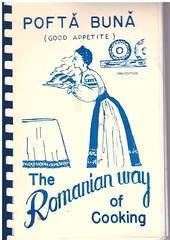
Pofta Buna (Good Appetite): The Romanian Way of Cooking
Dave’s grandfather gave us a cookbook, Pofta Buna, sold as a fundraiser by a Romanian Orthodox church in Cleveland, OH. It has recipes for chicken paprikash and other familiar foods.
Dave’s grandparents, John and Olympia, seem to have lived the mythical American Dream. They came to the US young and with an entrepreneurial spirit made a life for themselves in Detroit and found happiness and success.
Born in the US, returned to Romania
The children of two Romanian citizens, Dave’s grandfather and his sister were born in the US, so they had both citizenships. Prior to John’s birth, Dave’s great-grandfather (also John) wanted to come to the US, but his then-wife preferred to stay in Romania with her boyfriend. Maria Beretei did want to go, and they went together, unmarried. When John and his sister Mary were born in the US, they were illegitimate. When the family returned to Romania, Dave’s great-grandfather got a divorce from his wife and married the mother of his children.
John and Mary grew up in a small village in Romania near the Hungarian border, Chiribis, in the commune (seems kind of like a township in our terms) of Tauteu, in the county Bihor.
Lost his Mother Early
John and his mother got Typhoid when John was a pre-teen, and the doctor came to their house and said that if they made it through the tenth day, they would live. John’s mother died on the tenth day, and John lived.
Tusha Mary, their father, and John.
John’s father’s first wife had lost her boyfriend, and since John’s father had lost his wife, the two remarried. Yet, the children of the intervening marriage, John and Mary, were resented and treated poorly by his first-and-third wife. Young John got out as quickly as he could, taking a tailor apprenticeship in the big city as a teen, promising his sister he would get her when he could.
Came to the US on his own, then sent for his sister
Near the start of World War II in Europe, John made an application at the American Embassy to return to the US. Although he spoke no English at the time, he was an American citizen. He came to Detroit, where there was a strong Romanian community.
John was making his way in the US, and his sister was still in Romania, unwanted in her family home. One of John’s best friends, Florian, liked the look of John’s sister in a photograph, and he knew John wanted to bring her to the U.S. Florian said that he would help bring her to the US and there would be no obligation to marry him. After her arrival in the US, Mary married Florian. And Florian doted on her, sure he’d hit the jackpot. And maybe he did. I met Tusha Mary once, in her home in Dearborn, when Dave and I just started dating in 1994.
Making their Way in the US
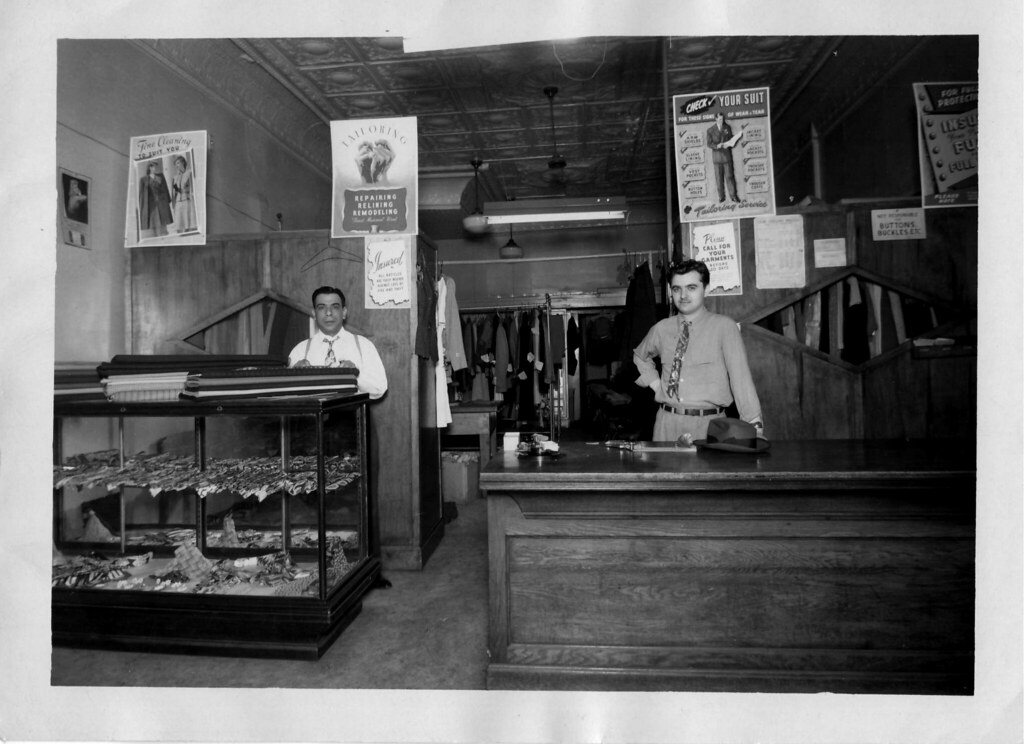
John made his way with confidence and personality, befriending and influencing people with his charisma and strength of character. He had good timing, coming to the Motor City during a boom time, and he had the skills and drive to prosper. John met and married a woman named Olympia, who had made her way to Detroit from a different village in Romania. John served in the US Army, and would have gone to the Pacific front but the war ended before he was deployed. Olympia worked in an auto factory (Ford) and after their wedding, John and Olympia lived in a duplex next to Unciul Florian and Matusa (“Tusha”) Mary. John and Olympia had a son and a daughter. John eventually owned his own tailor and drycleaner shop adjacent to the Rouge Plant in Detroit. They moved their home and shop from Detroit to Dearborn, moving into single family homes from the duplex.
Dave’s grandfather John (right) in his shop
Retirement in Florida
Eventually, John and Olympia retired to Florida. I met John and Olympia in the 1990s, well into their retirement. John was gregarious, friends with everyone he saw at Costco and other stores he frequented. He was a small man, and I’m tall, so I have a vivid memory of him sidling up to me on an early visit. He got very close to me, looked up, and asked me if I wanted a drink, eyes twinkling, loving to indulge his grandson’s girlfriend.
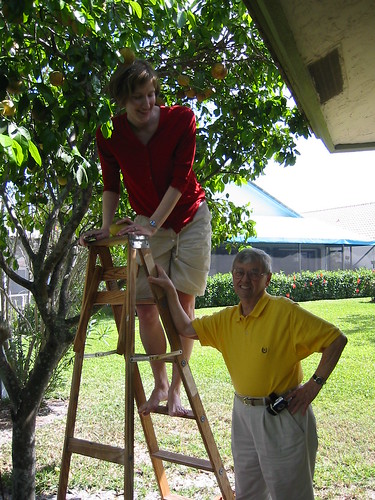
Me and John, taking down some grapefruit from his garden in 2004
I remember John’s tailor training showing up in the safety pins he kept tucked inside the waistband of his trousers, and in the clothing he liked to purchase on sale and give to his son-in-law and grandson. He knew what was made well and worth buying.
I knew Olympia less well. She was starting to slip away from Alzheimer’s disease as I became part of the family. One of her repeated stories was how much John’s sister Mary was like a sister to her. Olympia would show me, or anyone, Mary’s photo and profess her love for her. Olympia lost her English before she lost her Romanian.
John turned from husband to caretaker before she died, attending to her first in their home and then visiting her every day when she was in the Alzheimer’s ward of a nearby nursing home. My digital photos of Olympia are all from the nursing home, and they do not seem to capture her personality so I am not including them here.
Olympia passed first, then John got sick a few years later, and he passed away a couple of years ago now.
An Arc of a Life
A Romanian Orthodox priest presided at John’s funeral. And his burial was attended by an honor guard from the US Army. I thought about the funerals the Army honor guards must see, varying religions and ethnicities, coming together in the US and in the Army. I thought of John’s journey: from the US to Romania and back again as a youth, and then his path in the US, from immigrant to businessman to retiree, taking a turn through the Army on his way.
For me, I’m thankful for meeting John and I appreciate being a part of the family he and Olympia created. Like him, like his daughter, Dave and I love to entertain. So we carry on a few of the traditions, though perhaps keep more closely to the spirit of them than the specific details. We do offer people drinks and cook for them, yet unlike what is recommended in Pofta Buna, we do not boil our green beans for 40 minutes before serving them.
I appreciate the memories, which can be brought back now with a dinner or a shopping trip or some storytelling over a drink. John and Olympia, we miss you and are proud of you and we remember you. May we make you proud as well.
A show we’ve been watching on HBO for a few years had its final episode in its final season. It’s Treme, on HBO, focused on the people, the music, and the tribulations of a neighborhood in New Orleans after Katrina.
It’s from the creators of The Wire, and has some similar themes (crumbling, ineffective bureaucracy, crime, good people in impossible situations) yet is more place driven and upbeat than I remember The Wire being.
If you haven’t seen it, give it a shot.
We use cookies to improve your experience and analyze our traffic. Please see our Privacy Policy for more information.