Category: Life

  • Happy Anniversary, Janet & Nate! (gratitude #32)

    My in-laws are celebrating their 40th wedding anniversary.

    Happy Anniversary!

    True to form, they wanted to celebrate together with us: their daughter and their son and daughter-in-law. After a little bit of discussion, they decided on the location for the celebration – Cape Breton, Nova Scotia. It’s a fitting destination, the family camped here together often. Prior to this visit, their last visit was in 1994.

    We found a house to rent via HomeAway and now we’re here. We’ve been enjoying the seafood (oysters, crabs) and the scenic vistas here. We’ve had rainy weather (tropical storm Cristobal, perhaps?) so our pursuits thus far have been largely indoors: oat cakes, knitting, shopping for knitting supplies (Baadeck Yarns and Lorraine’s knitting shop in Neil’s Harbor), and fine dining (the home-cooked variety).

    But, on the occasion of their 40th Anniversary, I wanted to acknowledge the good times and warm welcome they have given me. My sister is moving near her in-laws, and was making a distinction in a conversation between “his” family and “hers.” She kept saying “they’re not my family.” I realized recently, I think when we drove down to visit Dave’s grandparents in Indianapolis, that after 14 years, his family is my family, not by birth, but by feeling and by association at this point, and I am sure it is Janet and Nate’s warmth and generosity that have made it so.

    I don’t want this blog post to be about me, but it is worth saying that, as a child of divorce and as a child in a family where 4 of 5 of my mom’s siblings got divorced, happy marriages kind of boggled me. I really didn’t get the rhythm of them or understand the give and take and the commitment involved. I knew what drove people apart, but not how they stayed together. Many people in Dave’s family, including both pairs of grandparents and especially Janet and Nate demonstrate such deep and abiding commitment to each other it just knocks me over. Last summer, when Dave and I stayed with Janet and Nate, I noticed how much Nate loved Janet. It was a simple thing, she and I had both gone out to run errands, and I had taken her car. I returned before she did, in her car, and after I pulled into the garage, I heard Nate calling to her from the garden. He sounded so happy she was back, it was sweet.

    That’s the kind of love these two demonstrate, on a daily basis, enjoying each other’s company and the company of their children. They’re not sickly sweet, Janet attributes her long marriage to “wine and alcohol” but I know there’s something much deeper that keeps them together.

    These two are a great example, one which I hope to emulate.

  • The Happiness Hypothesis

    The Happiness Hypothesis: Finding Modern Truth in Ancient WisdomI first heard about The Happiness Hypothesis from twitter, from @zappos tweet on having finished it, to be exact. I was especially interested in the premise of this book–a look at ancient wisdom and modern psychological research. Jonathan Haidt carefully reviews 10 ideas that have been threads in ancient wisdom and have been addressed in psychological research. Specifically, he looks at

    1. The divided self. The notion of a divided self (mind vs. body, left vs. right brained, new vs. old, controlled vs. automatic responses).
    2. Changing your mind. Our experience of the world comes from our perception of it. He goes on to explain that some people just “win the cortical lottery” and have a higher happiness set point (S) than others.
      • How to change S. Meditation, cognitive therapy, Prozac.
    3. Reciprocity with a vengeance. How reciprocity binds us together as a society. Why gossip is actually not as bad as the sages said (it provides a feedback loop on who can be trusted and is a form of bonding).
    4. The faults of others. How we’re so good at seeing others’ faults, and so blind to our own shortcomings. He details research on the four main causes of violence and cruelty (the obvious – greed/ambition, and sadism, and two less obvious and seemingly good – high self esteem and moral idealism). He then reiterates how meditation and self-examination can be used to reset the storytelling and encourage cooperation.
    5. The pursuit of happiness. How both lottery winners and paraplegics return to their set happiness point after the initial adjustment period ends. How we adapt to the conditions of our lives and take them for granted soon after they arrive. That happiness (H) is determined by the biological set point (S), the conditions of your life (C), and the voluntary activities (V) you do.
      • How to change C. It’s not money or prestige or fame. The external conditions that really seem to matter are noise, commuting, lack of control, shame, and relationships.
      • What Vs matter? Haidt draws a distinction between pleasures (eating ice cream…) and gratifications (moments of flow – experienced when using your strengths on a challenging problem). Gratifications last. According to Haidt, “activities connect us with others; objects often separate us….As a first step, work less, earn less, accumulate less, and ‘consume’ more family time, vacations, and other enjoyable vacations”. (pp. 100-101)
    6. Love and attachments. The stages of attachment to parents, caregiving to infants, and how it relates to our attachment to romantic partners. The differences between passionate and companionate love, and which is true love.
    7. The uses of adversity. Is it true that we need obstacles to fully realize ourselves? When is an obstacle a hindrance? It appears that family and social integration help people weather crises. So, for the isolated, adversity is more damaging. Youth confers a benefit of resilience as well.
    8. The felicity of virtue. The differences between character and actions. The 24 principle character strengths (test at authentichappiness.com).
    9. Divinity with or without God. The relationship between Flatland and the Bhagavad Gita. The effect of witnessing someone do a good deed: elevation.
    10. Happiness comes from between. The meaning of life, the meaning within life we create. Altruism, competition, and cooperation.

    The final message: it isn’t all about retreating to a mountaintop and meditating. We have to work on the internal (S) and on the external (C and V) to increase our happiness/well being. More on the book at happinesshypothesis.com

  • Gratitude is my top strength, from authentichappiness.com (gratitude #31)

    I took the VIA Signature Strengths test at authentichappiness.com (test is free, but requires registration on their site). Here are my top 5 strengths. The one thing that stands out to me is that my top strength in this survey is gratitude. Since I have been intentionally cultivating gratitude this year, I wonder if I would have tested strongly in it before, or whether I’m farming it in myself. Hard to know objectively, but I’m not sure I mind.

    1. Gratitude. You are aware of the good things that happen to you, and you never take them for granted. Your friends and family members know that you are a grateful person because you always take the time to express your thanks.
    2. Citizenship, teamwork, and loyalty. You excel as a member of a group. You are a loyal and dedicated teammate, you always do your share, and you work hard for the success of your group.
    3. Forgiveness and mercy. You forgive those who have done you wrong. You always give people a second chance. Your guiding principle is mercy and not revenge.
    4. Appreciation of beauty and excellence. You notice and appreciate beauty, excellence, and/or skilled performance in all domains of life, from nature to art to mathematics to science to everyday experience.
    5. Capacity to love and be loved. You value close relations with others, in particular those in which sharing and caring are reciprocated. The people to whom you feel most close are the same people who feel most close to you.

    I’m curious what some of my close friends and family strengths are. Test yourself and see at authentichappiness.com. For anyone leery, it’s part of UPenn and research on positive psychology, not some wacky Internet test with dancing bunnies at the end.

  • How I learned when to meditate

    I have had a meditation practice for several years now. I’ve been daily on weekdays for some time, long enough now that I think I might be addicted to it. This isn’t a bad addiction, a compulsion I need to shake, but it is interesting to notice my dependence, especially on something that has sometimes been a struggle for me.

    I have sometimes treated meditation like exercise, something that I will schedule and put myself through, because I know it is good for me. Like exercise, it hasn’t always been something I’ve loved for itself. During meditation, I sometimes clock-watch (like I might at the gym on a machine). I know it is good for me because of how I feel afterwards. I feel gentle, open, soft, and supported. I feel whole. But sometimes, during a meditation, the stress of just sitting there can be hard for me to bear. 

    A few weeks ago, I went up north with my family for a week. I made sure I meditated every day, but I was up there with kids, and wasn’t the earliest riser, and there is a lot of pressure to all be together for a big breakfast. So I felt rushed in the mornings and I did not take the time to meditate, Instead, I’d come downstairs to join the family for breakfast, my rhythm thrown off. I would then try to slip in a meditation during the late afternoon. While I still meditated each day, I noticed myself being grumpy, ill-tempered, and downright cranky until I had my meditation. The stuff I thought, the stuff I said. Yikes.

    I finally noticed the pattern. I noticed I didn’t like what was coming into my thoughts, and what was coming out of my mouth. So, I decided to change. I switched up my schedule, I resolved that no matter how late I slept, I would not come downstairs until I was finished. After my morning meditation, I felt more resilient and friendly towards everyone. It sounds obvious, now that I write it, but I had to learn through experimentation that I needed to meditate in the morning.

    Next I will experiment with duration.

  • Needing bread in response to a death in the family

    Last week, in the middle of a workday, I got a call about a death in the family. I was shocked and sad – Somboun, the guy who died, was young, in his thirties, my husband’s age or so, and seemed in full health. He slipped away in his sleep, without warning.

    I was busy, out of the office and about 10 minutes from a client meeting, so after a few quick moments of talking to family, I had to put on my game face and focus on the client and the project. After the meeting, I had the ride back to the office to think and talk, more phone time, and then a little bit of decompressing with the other riders in the car. I talked about my relationship with him, about his relationship to the family, about meeting him and what he was like.

    When we got back to the office, to the hub-bub of lunchtime and visitors, I was ready to shut down completely. I think I’d finally had enough time for it to sink in. The funny thing is, I really, really wanted bread. I had a salad, dressing, and some lovely smoked trout Dave had brought back from up north, but I wanted salt and crust and chew. So, I went out and got a Zingerman’s sea salt bagel. I never eat the salt bagels, tho I love salt, they’re usually too salty for me.  

    Usually I bolt my food, unhealthy I know. It’s just before I notice, I’ve eaten it all up. This time, I sat alone, not wanting to be social, and chewed thoughtfully. Perhaps in response to the news of the death, I was really able to focus on the taste of the food, its texture, the crunchy and sharp arugula, the bite of the garlic in the dressing, and thick and chewy bagel.

    Nothing like the shock of mortality to make being alive so tactile.

  • My Tweetcloud by tweetclouds and tweetstats

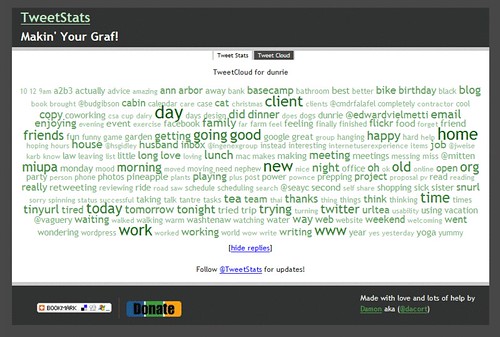
    I had some fun playing around with word clouds from my own twitter streams. Here’s a kind of random comparison of my tweet cloud from two applications – tweetclouds.com and tweetstats.com.

    Tweetcloud
    My tweetcloud seems pretty biased towards recent tweets – see “staycation”? I only said it once, just recently. looks like I retweet a fair bit, and that I talk a lot about gardening, soup, and yoga.
    Make your own tweetcloud.

    OK onto tweetstats. My tweetstats tweetcloud seems less centered on my last few tweets. “Ann Arbor” and “yoga” are less prominent, and “work” is more prominent. “client” “day” “home” “new” “time” “today” “work” and “www” seem prominent. I’m also noticing “tired” in there, and “tea”.
    Dunrie tweetcloud via tweetstats