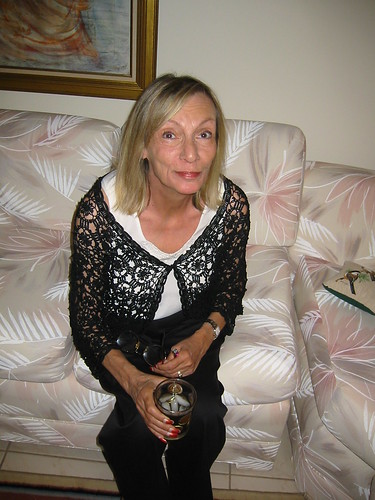
Ok, so I made a sweater once. It was an early sweater in my knitting life, and I just kind of made it up as I went along. The yarn was gorgeous gipsy hand-dyed wool from Fingerlakes Yarn. I wanted a shawl collar, so I made a shawl collar. I wanted a cardigan, so I made a cardigan. I wanted the edges of the sleeves and the hem to roll up the way that stockinette stitching does, and it did. That part was fun. My sweater design skills, tho, were beginning, so the pieces didn’t flow together. Cardigan + shawl collar takes more careful construction, and may not even make sense. I never got the buttons to work, so eventually I pulled off the placket and thought I might close it with a pin. To boot, I planned it during the period where I thought I might appear shorter if I drowned in my clothing. So, it could easily have fit me and a friend inside the trunk of the sweater.
The sweater was too expensive in terms of time and materials to let go of, yet too weird and too large to wear, so I finally decided to reuse the yarn in another project.
Reuse in action. Knitting up yarn pulled from an unused sweater into a rug.
Well, I ripped it apart the other night, deconstructed it from sweater to several balls of yarn, and now I’m knitting it into a rug diagonally, using a basic garter stitch scarf pattern. Couldn’t be easier. Next I’m going to felt it. It’ll be something warm for near the bed in the winter or maybe near a door.
Now I wish I’d taken a photo of the sweater, or the de-sweaterification of the yarn. But, here’s a photo of the rug in progress.
I’m trying to decide if I want it to be a big rectangle, or if it will be a series of squares seamed together. Now I’m going to look for other never-used knitted items I can pull to bits. If I keep this up, I’ll no longer have to purchase yarn (though I expect I will). Instead I could just pull apart and redo projects endlessly.
My stepmom, Barbara, died yesterday of liver failure. She was the mother of a son, a grandmother, and a great grandmother. She took care of my father in his illness and until his death. She loved to laugh and she loved her family, and she was generous and warm with me and my sister.
I wanted to write about journaling in the old days, before weblogs, micro-blogs, and Facebook. I want to write about old school journals, with pen and paper, specifically bound books of paper. I will share with you the reasons why I keep a journal, and how blogging has affected but not replaced my interest in keeping a personal journal.
Me, journaling in my Miquelrius notebook on vacation (Hawaii), helped by a cat muse (Dixon)
I have been keeping a personal journal for 29 years.
I am not exactly sure why I started a journal, or exactly when. The earliest journal I have in the plastic bin in my basement dates from 1980, when I was 10 years old. Those early journals are lists of daily events – we did this, we did that. This was boring, that was fun. I used lots of exclamation points!!!!! I wrote to my journal as if I was writing a letter to my best friend. I’d even address the reader as “you”. I have the sense I wrote to capture what it was like to be that age, so that I might have a record for when I was different, the older that I was always moving towards. Maybe I was lonely, maybe I was trying to escape what was happening in that moment. I’m not sure. I didn’t explain why I was writing.
Later on I commited to keeping a journal because I thought it was good practice. I wanted to be a physician who wrote books. Maybe like Chekhov, the Russian playright, or William Carlos Williams, the American poet, or maybe even Oliver Sacks, whom I hadn’t discovered yet, but who writes nonfiction about people and what we can learn about the mind and life from neurological conditions. I kept a journal for raw materials for whatever books I might write in the future because I had this idea that I would combine my parent’s lives. My dad was a doctor, a psychiatrist in fact, and my mom a high school English teacher before she had us kids, and an author when I was young. So, I kept a journal for raw materials.
I find I don’t have to sustain something for the original reasons I started. I haven’t become a physician, I’m not writing fiction, poetry, or any long or structured nonfiction. Yet, along the way, I think I learned that writing out my thoughts was good for me. I’m an external processor. I have to try to articulate my thoughts and feelings to understand them. And writing things out is a very safe way to practice thinking. People have this funny habit of taking what I say seriously, when I’m only trying it on, like a pair of jeans at the store. Seeing if it fits. I learned it was good for me to write, it was safe.
I write on planes, on trains, in buses, whenever there is a long period of time to fill or for reflection. I always take my journal on vacations. I write when I’m up north at the cabin. I write when I’m on a yoga or meditation retreat. I write after a big event or about a transition to help me understand and work through things. I write when I can’t sleep and am troubled by a worry or a conflict, I write in the middle of the night when only the cat is awake with me and I need solace and understanding.
You might think I use the journals for something. It’s odd, I almost never go back and read them. Sometimes if looking for something specific – a date of a critical event, maybe, I might burrow into them, but mostly they are written and forgotten. They are something my mind uses to process and to rid itself of things. I shed things by writing about them.
Years ago, maybe 10 years ago now I was on a plane, writing I suppose quite furiously in my journal, and the man next to me started up a conversation. He said he was a psychologist, and he cautioned me not to try to work everything out in my journal, that I needed to work out some of what I was trying to understand in the actual world. He cautioned me not to depend too much on the journaling.
My favorite journals are Miquelrius notebooks I buy locally at Hollander’s in Ann Arbor. The binding is durable, the pages are lined, they’re not too rigid or thick. They feel good, they travel well.
In the last few years I have been blogging. I started my blog in 2006, when I was working for a web company and trying to help our clients think about blogs, whether it would help them with SEO, how they might use it, and I wanted to be able to speak confidently about blogging, I wanted to live what I was recommending, so I started one in June 2006.
I found it added something different to my writing: the concept of an audience. I don’t actually imagine there’s a huge audience for these thoughts, but there are a few – especially friends and family – and the thought of a reader changed the writing somewhat. Enough so that I still keep the journal for the more interior, private thinking. This blog is a little less navel-gazing, a little less open, a little more polished than the journal.
And it has done what the psychologist suggested, helped me communicate a little more of my thoughts to others close to me. One nice benefit is it has helped me and my mom share more. Which is at least part of why some studies have shown that people who blog are happier, happier because they’re sharing. A little self-reflection, a little self-revelation. Both are good for the mood and the mind and the relationship.
So, I’m going to keep journaling privately to work out thoughts and practice thinking, and I’m going to keep blogging. Not sure if there will be other, more formal writing in my future, but this is good practice for now.
In honor of Earth Day, I want to celebrate my new discovery – a store called Muji. I encountered it when we visited London, but it apparently is all over the globe (including a few stores in the New York City area).
The store stocks practical no-nonsense items with minimal packaging. I walked out with a set of 3 socks, made from reused yarn. I knit socks, so I’m now officially a sock snob. I am now very sensitive to the materials and design of socks, and so I have a hard time buying obviously imperfect ones, even though the cost and time to knit a pair of socks is…exceptionally inefficient.
Anyway, Muji makes items (socks, tee shirts, camis) from yarn that was pre-dyed for some use and then never used, yarn that might have been discarded. The result is funky bright informal patterns, in 100% cotton, inexpensive and well-made. Fun, good price, quality, green! The Muji US website does not do the crazy cool rescued socks justice, but there’s the link in case you’re curious.
Helene Gidley, PMP of HSG Consulting, LLC. She is clear, thoughtful, organized, and direct. A leader and teacher of project management process. She’s also the founder of Agile Groupies on Ning.
As I sit here drinking my lovely cup of organic Shui Xian Oolong tea I can feel like I’m also doing a little thing for the environment. At least, if compared to the impact I’d make for the same amount of coffee.
I saw an amazing chart in the February 28-March 6 edition of the Economist. It compared the amount of water required to produce certain beverages and household goods. They took into account the water required for the production as well as the brewing of the beverage: producing beans for 1 liter of coffee coffee takes an amazing 1,120 liters of water. Tea is only 10% of that, at 120 liters. Astonishing.
To provide the best experiences, we use technologies like cookies to store and/or access device information. Consenting to these technologies will allow us to process data such as browsing behavior or unique IDs on this site. Not consenting or withdrawing consent, may adversely affect certain features and functions.
Functional
Always active
The technical storage or access is strictly necessary for the legitimate purpose of enabling the use of a specific service explicitly requested by the subscriber or user, or for the sole purpose of carrying out the transmission of a communication over an electronic communications network.
Preferences
The technical storage or access is necessary for the legitimate purpose of storing preferences that are not requested by the subscriber or user.
Statistics
The technical storage or access that is used exclusively for statistical purposes.The technical storage or access that is used exclusively for anonymous statistical purposes. Without a subpoena, voluntary compliance on the part of your Internet Service Provider, or additional records from a third party, information stored or retrieved for this purpose alone cannot usually be used to identify you.
Marketing
The technical storage or access is required to create user profiles to send advertising, or to track the user on a website or across several websites for similar marketing purposes.